
About us
About us
BACKGROUND
The Ghana Association of Former International Civil Servants (GAFICS) constitutes a pool of Ghanaians with extensive expertise in health, education, agriculture, social, economic, international development, humanitarian work and related disciplines. This wealth of experience has been garnered from working with the United Nations (UN) Organization and its specialized agencies, the World Bank, International Monetary Fund, African Union, African Development Bank, and other international organizations and governments, globally.
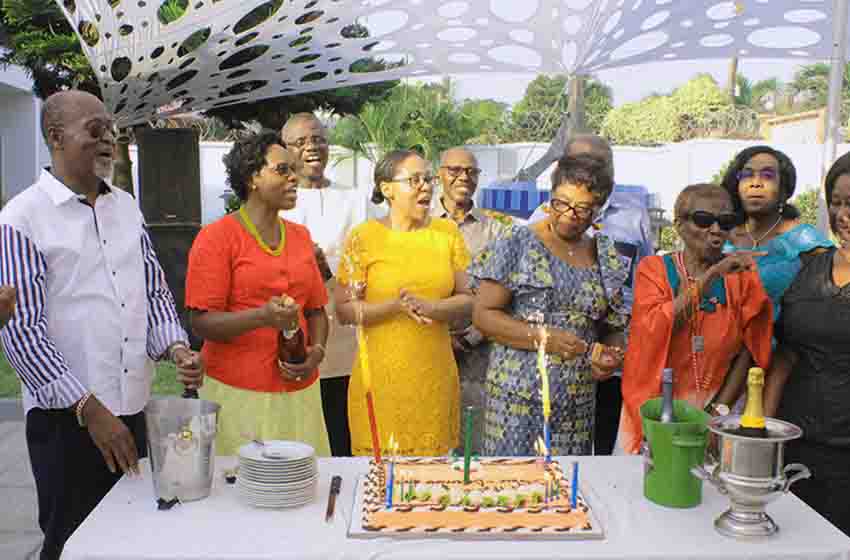
Having retired from their formal employment in the International Civil Service, and now settled in Ghana, GAFICS members desire to give back to society by placing their skills and expertise at the disposal of their country, including mentoring of the next generations.
GAFICS is committed to harnessing its global technical expertise and experience within various sectors for the social, economic, and technical development of the country through collaboration with the Ghana Government, national institutions, non-governmental organizations and community organizations.
AIM
The aim of GAFICS is to contribute to Ghana’s socio-economic development by making the extensive skills and expertise of its members available to the country. The overarching goal is for its members to give back to society in appreciation of the support and investments made in their education and personal development, that contributed to their career trajectories.
OBJECTIVES OF THE ASSOCIATION
1. To develop and maintain a database on the professional expertise of its members, as a basis for offering relevant technical and advisory support to the Government of Ghana and other institutions, where needed.
2. To organize lectures, seminars, workshops and other activities that promote the goals of the Association and contribute to Ghana’s socio-economic development.
3. To assist members with personal needs in relation to their resettlement and adjustment upon their return to Ghana, and to foster social cohesion among members.
ACTIVITIES
To date, GAFICS has supported various activities in the health, education and humanitarian sectors in Ghana, examples of which are briefly outlined below:
● Donated funds, computers and furniture to schools, especially in deprived communities, and sponsored pest control spraying of classrooms.
● Supported the National Youth Council Training Programme to sponsor needy school leavers to gain vocational skills; some Ghanaian NGOs to provide environmental education to primary and secondary schools; and mentoring programmes for Senior High School graduates.
● Contributed to the COVID-19 National Trust Fund to support vulnerable groups during the Covid-19 pandemic; supported the fistula programme in the Northern Region of Ghana; and sponsored needy patients for cataract surgery.
● Provided material and financial support to communities affected by the Volta dam spillage in 2025.
● Provided technical support and advisory services to government ministries and institutions in the Health, Education, Gender, Child Development, Social Protection and Humanitarian sectors.
THE GAFICS PUBLIC LECTURE SERIES
An important GAFICS initiative is its Public Lecture Series. GAFICS has organized several public lectures on topical issues, based on national need and guided by the expertise and interest of its members. Recent examples include:
- The Ghana Fishing Industry – Who gains and who loses? by Dr. Kwame A. Koranteng, September 2019.
- Numbers Count – Strengthening Data-Based Planning for Development, by Dr. Andrew Arkutu, October 2019.
- Climate Change and the Energy Transition and its Implications for Ghana, by Kojo Osei Busia, April 2022.
- E-levy and its Implications on Economic Agents in Ghana: Is there an Alternative Approach? By Andrew Holmes, May 2022.
- Food Security: Transforming our Food Systems to deliver Healthy Diets, by Professor Anna Lartey, June 2022.
- Unlocking the Economy, Governance, and Peace Nexus in Ghana. A Road Less Travelled, by Angela Lusigi, UNDP Resident Coordinator. August 2022.
- Taking International Negotiations Seriously, by Nana Dr. S. K. B. Asante. October 2022.
- UN@80: Recalibrating the United Nations in a world that no longer agrees with reality, by Zia Choudhury, United Nations Resident Coordinator in Ghana. April 2026.
PUBLICATIONS
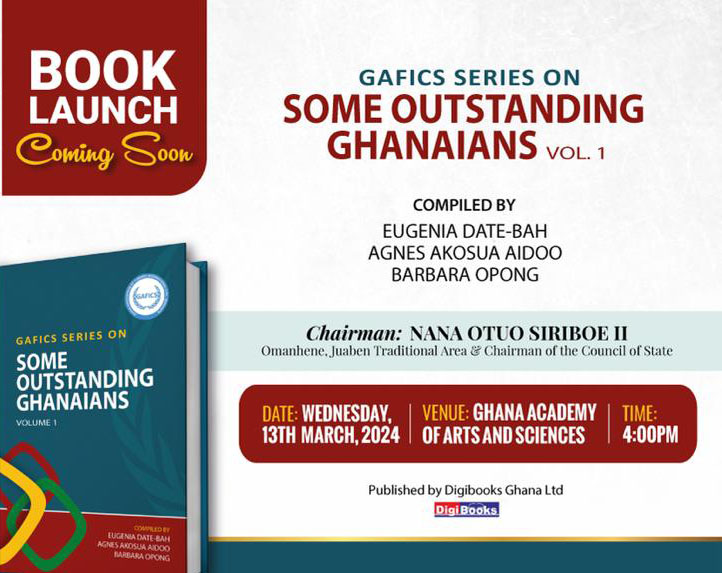
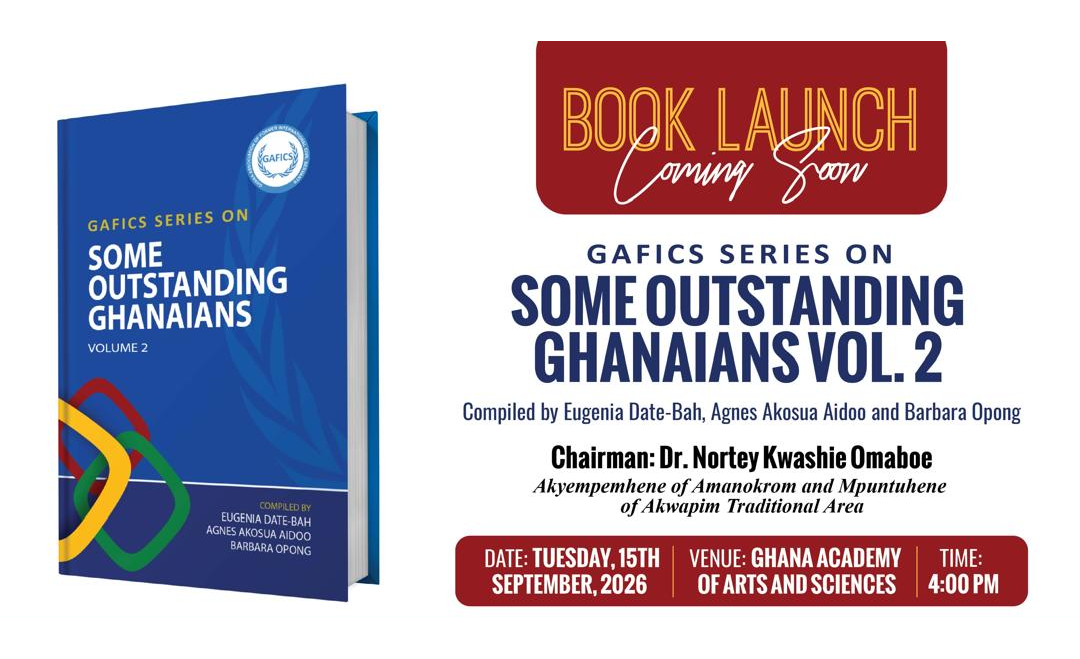
A major publication titled “GAFICS Series on Some Outstanding Ghanaians” was initiated by GAFICS in 2021, with the aim of documenting and highlighting aspects of the lives and achievements of Ghanaians who have contributed significantly to the development of their communities, country and/or other parts of the world, but remain relatively unrecognized for their work. It is intended to constitute an accessible repository of Ghana’s institutional memory about these illustrious Ghanaians by highlighting their contributions to society. It is envisioned that the series will serve as an inspirational and educational tool that will motivate others to achieve more.
The following two volumes, compiled by Eugenia Date-Bah, Agnes Akosua Aidoo and Barbara Opong, and published by Digibooks Ghana Ltd., are available:
Volume 1, March 2024. ISBN: 978-9988-9245-3-9
Volume 2, September 2026. ISBN: 978-9988-9581-2-1
GOVERNANCE
GAFICS was incorporated under the Ghana Companies Code, 1963 (Act 179) on 26 September 2000 and formally inaugurated in April 2001. With an initial membership of 28 in September 2000, GAFICS now boasts of over 120 active members.
The Association is governed by an Executive Committee led by a President. To facilitate effective contribution to national development, six (6) Cluster Groups by discipline and area of expertise have been formed to deliberate on topical issues and make recommendations through public lectures and other forms of communication, when needed.
The Cluster Groups are: i) Economy, Trade and Investment; ii) Health, Nutrition, Population and Social Development; iii) Education; iv) Peace and Governance; v) Infrastructure and Environment; and vi) Food and Agriculture.
Given its importance as an educational and legacy initiative, the Unsung Heroes and Heroines Project, whose major output is the publication of “The GAFICS Series on Some Outstanding Ghanaians” has a governance structure comprising a Steering Committee and operational Sub-Committees for selection of candidates, book development, sales and marketing and monitoring and evaluation for accountability purposes.
Members of the Association are affiliated with the following organizations: The United Nations Secretariat, United Nations Development Programme, United Nations Children’s Fund, United Nations Population Fund, United Nations Educational, Scientific and Cultural Organization, United Nations High Commissioner for Refugees, World Health Organization, International Labour Organization, International Maritime Organization, Food and Agriculture Organization, World Bank, International Monetary Fund, African Development Bank, Commonwealth Secretariat, African Union, Economic Community of West African States and other international organizations.